





You've evaluated the platforms, built the business case, and you know that a Computer-Aided Facilities Management (CAFM) system will transform how your organisation operates. Then you walk into the boardroom, finance stares blankly at your slides, and the answer is 'not this year.'
The problem is that finance speaks money, and we speak in facilities management. By reframing your pitch, you'll be able to get finance on board, so your facilities management software will get the green light.
Translating 'Operational Efficiency'
'Operational efficiency' means nothing to a Finance Director.
Every day, facilities management phrases, such as 'streamlined workflows' or 'improved visibility', are not part of their day-to-day. To someone in the finance team, these phrases are vague and unquantifiable.
Finance team's care about three things:
- Cost reduction
- Risk mitigation
- Capital planning
If your CAFM business case doesn't speak directly to these three pillars, finance won't see the benefit. To get them to see the ROI, you'll need to translate every FM benefit into a financial benefit.
Reframing Your Vocabulary
When you tell finance that your team will save 2 hours per engineer per week, they can't put that into the budget.
You need to reframe the information so that it applies directly to the budget.
For example, 'a reduction in manual work order management will reduce labour variance by £24,000 annually, based on eight engineers at £15/hour, saving two hours a week for 50 weeks'.
Apply the same logic and reframing throughout your case.
We know that preventative maintenance means fewer surprise repairs and better planning, but that doesn't translate into figures for finance. When 'better data' becomes 'budget certainty', a £50,000 repair can be planned, which is better than a £50,000 emergency that cannot be explained.
You'll find that the finance team is more likely to see ROI when they can see the data and the numbers that inform budgets.
3 Levers That Build Your Business Case
Stop padding your business case with soft benefits and focus on these three hard cost levers instead.
Lever 1: The Reactive vs Planned Maintenance
You are almost certainly paying a premium for reactive maintenance.
Emergency contractor call-outs typically cost 40–60% more than planned, scheduled visits.
To show how much a facilities management system could save you:
- Pull your contractor invoices for the last 12 months.
- Separate reactive call-outs from planned visits.
- Calculate the premium.
- Find the asset lifecycle extension.
- Prove that CAFM extends the useful life of your assets.
An asset with a five-year replacement cycle costs far less if that cycle extends to six or seven years. Model this for your top ten assets to show how quickly savings compile. Planned maintenance significantly benefits an organisation.
Read More about Planned Maintenance
Lever 2: Ghost Spend
'Ghost spend' is the money wasted on poor asset performance or on space nobody is using.
It can be almost invisible without the data to back it up. So, utilising CAFM platforms to informed decisions is one of the easiest ways to reduce costs.
CAFM's real-time data tells you which assets are utilised and which are not. This means you can reduce soft services, like cleaning and utilities, for underused zones.
If your estate includes multiple sites, even a single lease renegotiation or consolidation driven by CAFM data can deliver savings that dwarf the cost of the platform itself. Total facilities management strategies integrate space data across a whole estate to deliver financial returns.
With CAFM data, you can make data-driven decisions that lead to direct budget reductions.
Lever 3: Compliance Cost Avoidance
Compliance failures are expensive. They can result in fines, remediation, reputational damage, and operational disruption.
The failure in:
- Statutory inspection
- Fire safety certificates
- HSE audit.
These are just some of the areas where compliance incurs real costs that rarely appear in the 'cost of the status quo' column of a business case.
CAFM systems help manage facilities and the documentation needed to keep them running smoothly. Learn more about Staying Compliant: How CAFM Software Helps You Meet UK Regulations.
A Guide to the ROI Formula
To ensure that finance can see the long-term benefits of implementing a CAFM system, you can model the ROI formula in your presentation.
This formula will help your case withstand the CFO's scrutiny.
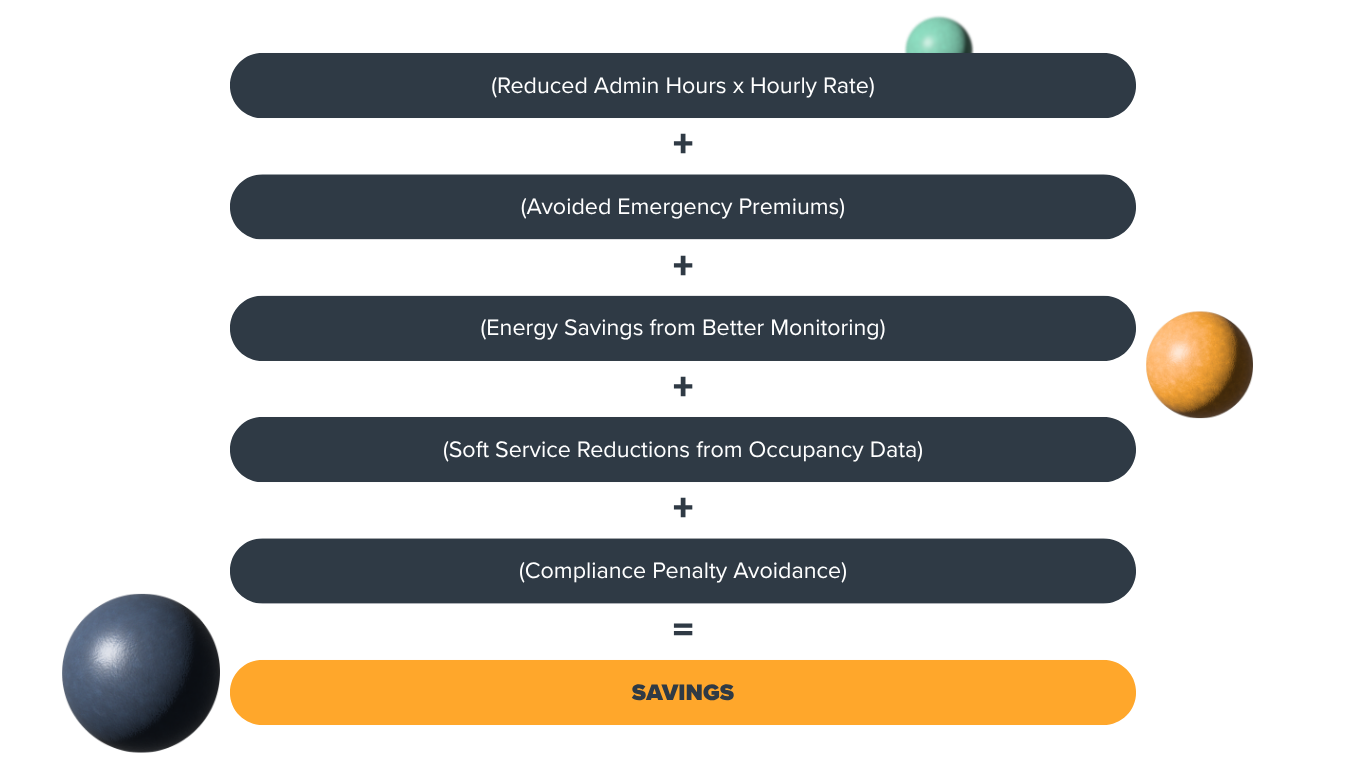
Your total hard savings are calculated as follows:
Next, calculate the cost of implementing the CAFM software:
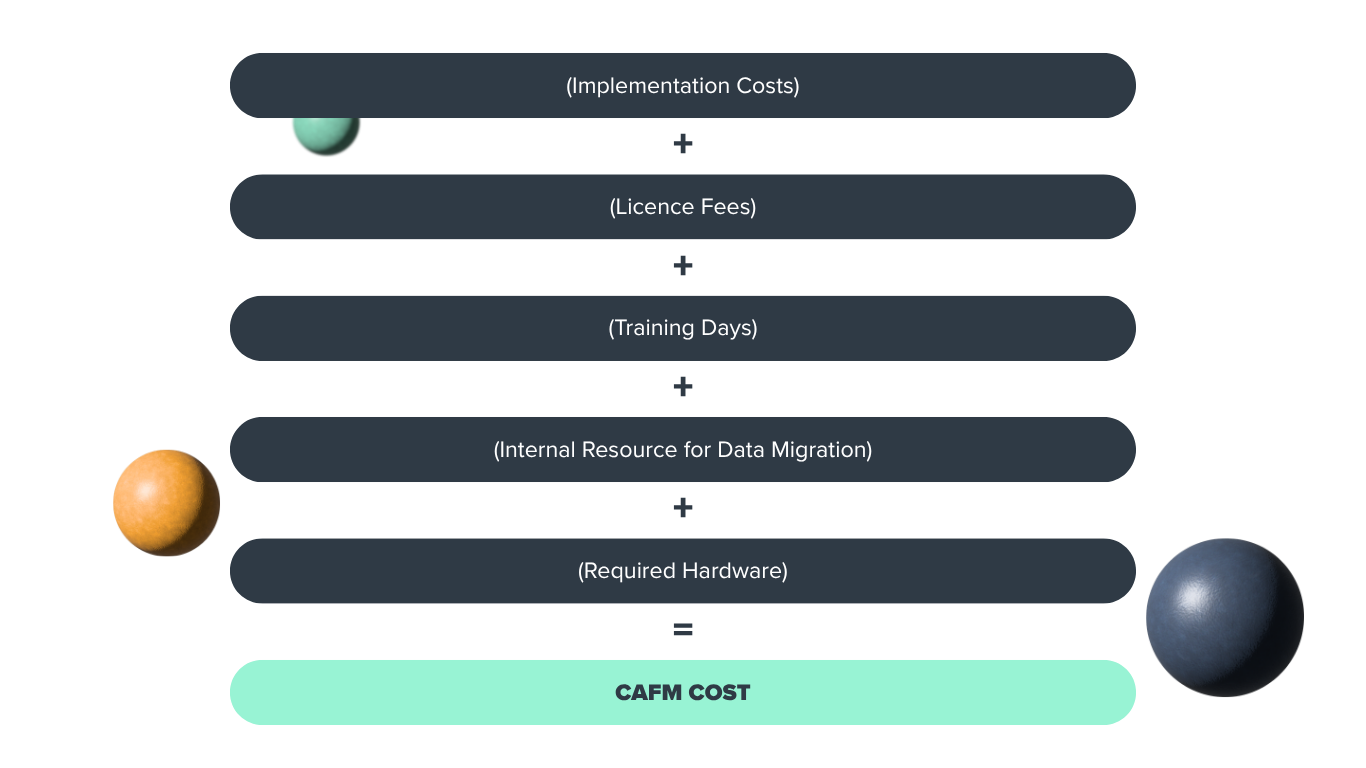
It is important to be transparent with these costs because hidden costs that emerge post-approval will impact credibility and future business cases.
To show your ROI as a percentage:

Top tip: It is far better to understate your cost savings and exceed them than to oversell and be held to an unrealistic figure.
Many organisations find that a well-structured CAFM implementation, when properly costed against actual savings, delivers payback within 12 to 24 months.
Read More about Calculating ROI for CAFM
Lead With the Payback Period
Your executive summary should open with your payback period. Use the formulas above to calculate how many months it will take for the investment to break even. Then, show the annual savings.
Leading with the payback period has more impact on the finance team than three pages of narrative. Follow it with your top three hard savings, stated as annual figures.
Keep the information concise and clean. Use one page, one timeline and the most impactful three numbers.
Risk Mitigation
This is the most underused tool in any business case. Most presentations argue for the benefits of saying yes, but few explicitly articulate the risks of saying no.
Include a clear, concise list of what risks remain if the board declines:
- Compliance failures
- Compliance penalties
- Continued reactive maintenance costs
- Growing asset liability
- Lack of asset lifecycle visibility.
Finance does not like open-ended risk. If you frame your presentation as a way to manage risk, it can move the conversation.
Explaining CAFM vs CMMS
Many finance teams conflate CAFM with CMMS (Computerised Maintenance Management Systems).
CMMS is a maintenance tool, and CAFM is a strategic asset management platform. A CMMS manages maintenance schedules. This is useful, but it's only operational. A CAFM system manages your entire estate.
The board doesn't want to manage FM.
They want to know that FM won't cause them a problem. A CAFM system gives them that confidence because it is a maintenance software solution and a risk management platform.
Key Takeaways
The three fixes you should show CAFM's ROI to finance are:
- Translate your language
- Focus on hard cost levers
- Present with financial discipline.
These fixes are effective, but they require you to pull data, build a real model, and resist the temptation to pad your case with soft benefits.
You already understand the value of CAFM. Now you need to make the finance team understand it too.
Read More on How to Build a Business Case for CAFM